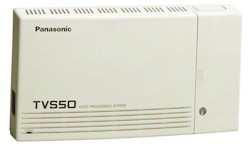
- Panasonic uses the term "Voice Processing System" to
designate a multi-purpose box providing a long list of versatile features in four basic
categories: automated attendant, voicemail, interview, and
"custom service," which almost lets
you design your own machine. The KX-TVS series voice processors are compatible with any
phone system that will work with single-line phones, but they really shine when connected
to a Panasonic phone system.
- A Voice Processing System is designed to work with
a phone system control unit ("KSU"). You don't connect phone lines or phones directly to it, as you would with an answering machine.
- Installation is much easier than with Panasonic's previous KX-TVP150
voice processor. The KX-TVS models can be open for business within an hour of
hanging-up and plugging-in, but you'll probably fine-tune the programming over a period of
weeks and months, as you get familiar with the features and options.
- Messages are recorded on a computer-type hard drive
in the KX-TVS75, 100, 110, 120, 200, 220, 300 and 320; and in solid-state "chip" memory
in the KX-TVS50, 80 and 90.
- The KX-TVS320 has a built-in modem for remote programming and diagnostics.
| Model |
number of ports |
number of mailboxes |
recording time |
| KX-TVS50 |
2 |
32 |
2 or 4 |
| KX-TVS75 (discontinued) |
2 |
64 |
6 hours |
KX-TVS80
(discontinued) |
2 |
64 |
6 hours |
| KX-TVS90 |
2 |
64 |
6 hours |
KX-TVS100
(discontinued) |
2 or 4 |
64 |
16 hours |
KX-TVS110
(discontinued) |
2 or 4 |
64 |
16 hours |
| KX-TVS120 |
4 or 6 |
64 |
32 hours |
KX-TVS200
(discontinued) |
4 or 8 or 12 (digital)
2, 4, or 6 (analog) |
1024 |
32 hours |
KX-TVS220
|
4 or 8 or 12 (digital)
2, 4, or 6 (analog) |
1024 |
64 hours |
KX-TVS300
(discontinued) |
4 to 24 (digital)
2 to 12 (analog) |
1024 |
64 hours |
KX-TVS320
|
4 to 24 (digital)
2 to 12 (analog) |
1024 |
128 hours |
| Number of ports indicates the number of simultaneous
conversations that can be handled. If you want the system to provide automated attendant
service as well as voicemail, you will need more ports than if it provides voicemail only. |
- Voice recordings are stored on a hard drive or
solid-state "flash" memory within the voice processor cabinet. Recordings should still be intact after a power failure. To maintain
operation during a power failure, you will need a UPS (Un-interruptible Power Supply) for
both the VPS and the phone system. Plan on spending about $220.
- Each mailbox can hold up to 99 messages. Through programming, you can
change the maximum number of stored messages, the length of storage time, and other
parameters.
- Programming is usually done
with a PC, plugged into a serial port on the VPS cabinet, with an
AbleComm
ProCable or a serial cable and null modem adapter from RadioShack.
- Unlike the Panasonic digital phone systems, you do NOT
need specific software for programming a VPS, because the software is
imbedded in the system. You can use almost any communications software. I usually use
HyperTerminal (supplied with Windows). You can also get
excellent Windows
software.
- If you are in the Mac world, you
don't need a null-modem adapter. Friend/Client/Ace-D-I-Yer Don Ayres of Camptoons has had
good results with a Mac serial-to-25 pin cable and Global Village comm software.
- It's hard to describe "Custom Service," because it doesn't
exist until you create it, and you can make it almost anything you want. Basically, it
allows you to assign any of 14 different functions to a button on a touch-tone pad. After
hearing the opening greeting, a caller can navigate though a hierarchy of
functions...receiving information, leaving voicemail, talking to live human beings,
accessing the PA system, taking a survey, ordering pizza, complaining about pizza,
learning about job openings and monthly specials, getting travel directions, leaving
suggestions, and more. Up to 100 custom scripts can be created, and made available to
whichever phone lines you choose. You probably can't go wrong if you set-up your system
for custom service.
- One voice processor connected to one phone system, can conduct
several very different businesses, at one time.
- The KX-TVS units can speak different languages. They come off
the plane speaking fluent English, but you can record phrases in your choice of two other
tongues. The KX-TVS90, 120, 220, and 320 are manufactured with both
Spanish and English prompts. The opening greeting can allow the caller to pick the language he or she is most
comfortable in, and you can even program different incoming phone lines to be answered in
different languages -- great for a multi-ethnic law practice or medical center.
- The voice processors have built-in CNG tone recognition. When the
tone is detected from an incoming fax, the call will be sent to your fax machine or fax
modem. This feature won't work unless the VPs answers calls immediately,
which might not be practical for your situation. If you want to share a
line with fax and people, and want most calls to be answered by people,
use an external fax/voice switch.
CLICK for the switch.
- Installation should be easy, especially when a voice processor is
mated to a Panasonic phone system with "APITS" or "DPITS" integration." After a
little bit of keyboarding, the "Quick Set-Up" utility lets voice processor and
phone system exchange information to automate many of the programming parameters.
- Starting with products shipped by Panasonic
in October 1996, the KX-TD816 does have DPITS.
You can get upgrade chips to add DPITS to older 816 systems from
AbleComm,
at 1 888 ABLE 999.
- The KX-TA624 has
APITS, which is almost as good as DPITS.
- The old KX-T616
and KX-T308 are simply the pits, when used with voice processing.
FUGGEDABOUDIT!
- Early versions of the KX-TD1232 do not have
DPITS. You can determine if your software has DPITS, by using programming code 116, which
shows the software version, such as P101A 50508B. The underlined digits represent
the software production date code, in YMMDD format. The example above indicates May 8,
1995. For DPITS, the software date must be March 31, 1995 or later. If your software date
is earlier, you can get a software upgrade from AbleComm, at 1 888 ABLE 999.
- The KX-TA1232 is
an analog system, but has DPITS like a digital system.
- With DPITS, a single phone cord, connected to the data pair of
a phone port in a Panasonic Digital Super Hybrid control unit (or the
KX-TA1232), will carry TWO
simultaneous conversations plus data interchanges, just like an ISDN phone line can carry
multiple voice and data transmissions.
- When the Voice Processor and phone system communicate over a data
pair, all the status and switching information is transferred "out-of-band."
Hardware can talk to hardware at the same time that human talks to human. And instead of
using time-wasting sequences of flashes, pauses and tones, there is an
almost-instantaneous burst of data, which allows a high degree of feature flexibility, and
extremely fast call transferring.
- Without DPITS, you will
need one modular cord for each port.
- If you are using an older
KX-T123211D, you will have to program extension groups in the control unit
("KSU") for the station ports that will be connected to the Voice Processor.
- Without DPITS, you will NOT HAVE: Live Call
Screening, Remote Live Call Screening, Two-way recording, Two-way transfer, Intercom
paging, automatic configuration, and high-speed mailbox access.
- A serial connector on the Voice Processor allows you to easily
connect a PC for programming features, and to download various kinds of reports on human
and machine activities. If the Voice Processor is connected to an external modem, you can
check in from anywhere to make changes and find out what's going on.
/mnm
Click for installation
instructions
|
 Home Email Catalog
Main Page
Online Ordering
Home Email Catalog
Main Page
Online Ordering