 |
PHONE
WIRE |
Each phone line (i.e. each phone number) is an electrical circuit requiring two wires,
just like a hi-fi speaker or a light bulb or bicycle horn.
In some areas, fiber optics or other new technology eliminates the need for a complete copper
path of wire stretching all the way from the phone company's central office to
your phone, but you can assume that almost every phone is connected to between several
feet and several miles of low-tech copper wire.
The two wires carrying a phone circuit are generally considered to be a "pair,"
and are usually twisted together and joined with one or more other pairs, inside an outer
protective plastic jacket, to make up a multi-pair wire or cable. Multi-pair wires are
typically available with two, three, four, six, or twelve pairs. Beyond twelve pairs, as
the wire bundle get thicker, it is generally referred to as a cable,
rather than a wire.
"Cable" sounds more impressive than "wire," but they often mean the
same thing. There is no fixed point where wire gets big enough to be called cable. A big
boat is a ship, and big wire is cable.
The wire running around inside the walls of most homes and offices has from four to
twelve conductors, often arranged as two to six pairs, with each pair
twisted together.
Until the mid 1980's, 25-pairs was standard for business phone systems; and many
apartment houses, particularly in New York City, were pre-wired with
25-pair cable going from room-to-room.
If a house or office is being built for you, you can specify any kind of wire you want.
Twisted-pair wire varies
in the number of twists per inch. Wire with more twists is better and more expensive.
Twisted-pair wire (usually un-shielded, and called "UTP")
is classified in various levels or categories. Computer
networks generally use Cat5, Cat5e or Cat6 wire, and phones Cat3 or Cat5.
Cat5 and higher numbered
category wire is capable of higher data
transmission speeds, and must be installed properly to avoid loss of speed and data glitches.
Special phone jacks and other hardware items are available for use with this wire.
In the wire pair, one wire
(conductor) has positive electrical
polarity, and is called the tip and is traditionally green within a phone
jack. The other is negative, called ring, and is red. The tip and ring terms
come from the parts of an old-fashioned telephone switchboard plug.
NOTE: Phones that are idle or being used for
talking, use DC (direct current). Phones ring on AC (alternating current);
so while a phone is ringing, polarity is constantly changing.
Multi-pair phone wire
uses an industry-standard color code, to distinguish one pair from the
others. Each wire usually has a base color and a contrasting stripe, and the other wire in
the pair is the opposite.
The first pair of wires usually has a
white wire with blue stripes, and a blue wire with white stripes. There are codes for 25
different pairs. When cables have more than 25 pairs, each group of 25 pairs is wrapped
with colored nylon thread, in a binder group.
Wire thickness is indicated by "gauge." It is pronounced,
and sometimes spelled. "gage." A higher gauge number indicates a thinner wire.
Thicker wire allows a signal or voltage to travel a longer distance without noticeable
degradation.
The electrical wire in your walls is usually 12 or 14 gauge. A lamp cord is usually 18
gauge. Phone wiring is usually either 22 or 24 gauge. Unless your home is Buckingham
Palace, you don't need 22 gauge. However, the price difference between the two sizes is
negligible, and the thicker stuff is a bit stronger and less likely to be broken by
amateurs, so there is no reason not to use it. You probably won't find Cat-5 in 22 gauge.
Phone wiring is always solid, never stranded like lamp cords or
speaker wires. In an emergency, or if you have a special need, you can make a phone work
with pretty much any kind of wire (flat TV antenna "twinlead" wire can hide
under carpeting), but you'll get the best possible results if you use the proper
materials, particularly if you have two lines. It's difficult to connect stranded wire to
phone jacks without causing short circuits.
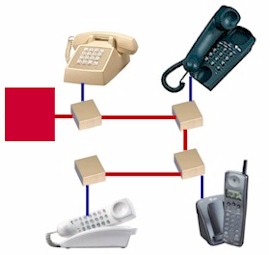
Residential wiring is most often installed in a "loop-through"
configuration, where wire goes from the phone company's entry point to one room, then
another, and another, and another, in a string. The phone jacks are wired electrically in
parallel, but physically in series, and a break in the series can knock out phone service
in several rooms 'after' the break.
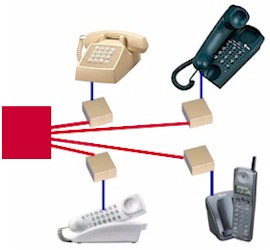
If you have the option, it is much better to install home-run wiring, where there is a
direct path of wire from the phone company's entry point to each phone jack.
(Computer guys call it star topography.)
With home-run wire, a break in one segment will not kill service to other parts of the
office or house, and other problems such as short circuits or grounded wires may be more-easily
identified and fixed.
We have an extremely good "connecting block"
that makes it easy to install home-run wiring.
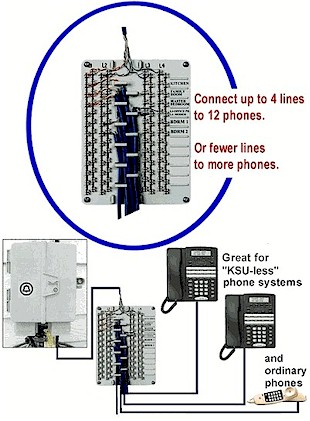
CLICK for more info
and ordering.
Loop-through is less-expensive and OK for ordinary non-system
phones, but not the best choice.
Home-run wiring also makes it easier to install a more elaborate phone system that
requires a central control box, commonly called a Key Service Unit
("KSU"). Wire is the cheapest part of a phone installation. It is always better
to to have too much than too little. Spend a few cents extra per-foot and install
four-pair wire, which is considered standard today, even if your phones will work on fewer
pairs. This will give you some reserve to add an extra phone, or a fax or answerer or
modem on another line; or to compensate for wire damaged by a plumber or carpenter.
You can also use an extra pair or two to carry music to a speaker, or as a computer LAN
(Local Area Network). Macs usually use one pair, IBM usually two pairs. If you think
you might be using the same wire for both phones and computer, definitely spend a few
cents more per foot to buy Cat-5 wire, instead of the Cat-2 or 3 more commonly used for
phones alone. If you know you'll have a LAN, go first class, with separate wire
for phone and data. It's cheaper to prepare now, than to bash or knock down your walls
later.
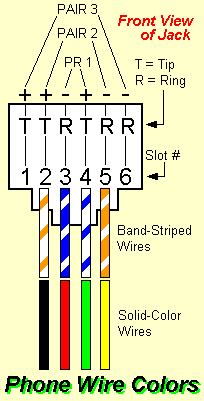
There is an industry-standard color code for identifying the pairs in a multi-pair wire
or cable. Each pair consists of one wire with a base color and contrasting stripe, plus
another wire with the opposite colors. The first pair, used for line # 1 consists of a
white wire with blue stripes, plus a blue wire with white stripes. The second pair, used
for line #2, is a white wire with orange stripes, plus an orange wire with white stripes.
Line #3 is white with green, and green with white. Line #4 is white with brown, etc. Line
#5 is white with gray (which phone pholks call "slate"), etc. Line #6 is red
with blue, etc.
As with all industry standards, there are many exceptions. Sometimes you'll find that
the first pair consists of a solid white wire and a solid blue wire. And the second pair
is solid white and solid orange, etc. And sometimes you'll find that the first pair is a
solid blue wire, plus a white wire with blue stripes, and so on. And sometimes you'll find
green and red for the first line, black and yellow for the second, and white and blue for
the third. And sometimes you'll find orange, brown and slate (gray) wires.
CLICK for color codes for wire & jacks
For many years, most phone companies installed 4-conductor wire
in homes, and this is what you'll usually find hanging on racks in electronic stores.
Instead of having multiple pairs, they have four wires twisted together. This is a bit
cheaper to make than twisted-pair, but is more likely to result in "crosstalk,"
where voices, sounds or signals from one line leak through and are heard on the other
line.
Some 4-conductor wire, such as ATT (now probably labeled Lucent or
Avaya), is quite good and unlikely to cause
crosstalk. Other apparently-identical wire is often sold for alarm installations, but is
not twisted properly for phone use, and can cause terrible crosstalk problems. To be safe,
go with twisted pairs, and the more pairs, the better. |
X |
 |
 |
PHONE JACKS &
PHONE PLUGS |
The little plastic tips on the ends of
phone cords and cables are modular plugs. They fit into modular
jacks. Despite their male name, jacks are female. Plugs are
male. If you don't understand this, the next time you're naked, look in the
mirror.
The word "modular" refers to a
phone construction format introduced by AT&T in the1970s, that allowed installers to
assemble phones at customer locations by selecting specific components that plugged
together, instead of needing hard wiring. The modular connector design
was also applied to the jacks that phones plugged into, to get dialtone.
 Modular plugs are made in three sizes: Modular plugs are made in three sizes:
- The smallest plug, known as 4-position,
4-wire, is used for handset cords. A position is a groove molded into the
plastic that could contain a little bit of gold-plated wire to make contact with
wires inside the jack.
- The middle-size plug is the most common. It
has six positions, and either two, four, or six wires. It is used for most line cords that
connect phones, modems and other devices to phone jacks.
- The largest plug, with eight positions and
eight wires, is usually used for LANs (Local Area Networks) and sometimes
for four-line phones. It is often called an RJ45, but that designation is inaccurate for
LAN connections.
-
 Eight-wire
plugs and jacks are also used on some ATT/Lucent phone systems.
If you are going to re-use jacks previously
installed for a Merlin or other ATT / Lucent / Avaya phone system that uses the
"T568B" wiring scheme, you will either have to re-arrange the
wires inside the jack, or connect the circuit that would normally go on
the white/orange wire pair, to the white/green pair. Eight-wire
plugs and jacks are also used on some ATT/Lucent phone systems.
If you are going to re-use jacks previously
installed for a Merlin or other ATT / Lucent / Avaya phone system that uses the
"T568B" wiring scheme, you will either have to re-arrange the
wires inside the jack, or connect the circuit that would normally go on
the white/orange wire pair, to the white/green pair.
At least 99% of all phone jacks used with one-line phones are really two-line jacks. In
the same actual jack, if two wires are connected, it's a one-line jack. If four wires are
connected, it's a two-liner.
The FCC and phone companies have codes to identify how jacks are wired. A single-line
jack designed for mounting a wall phone is an RJ-11W. A single-line jack for a table or
desk phone is an RJ-11C. Two-line jacks are RJ-14W and RJ-14C. Three-line jacks are RJ-25.
If you know that much, you know more than many phone company employees. Four-line jacks
are RJ-61. If you know that, you know more than all phone company employees.
"RJ" stands for Registered Jack. "W" stands for Wall. Apparently only
one person knew what the "C" stood for, and he died without telling anyone.
 |
If you look at the springy wires inside a common phone jack, the two
inner ones are used for line #1, and the two outer ones are used for line #2. The flat
cords that commonly connect phones to phone jacks follow this same arrangement.
|
Cords used for three-line phones have two additional conductors for the third line,
outside the second pair, for a total of six wires (three pairs). If you look at a
cross-section of a six-conductor phone cord, the line circuits could be considered to look
like this: 321123. If you plug a single-line phone into a two-line jack, it will work on
line #1. If you plug a two-line phone into a three-line jack, it will work on lines #1 and
line #2.
Four-line cords have two more wires (total of eight wires, in four pairs). Four-line
non-system phones can use two two-line cords, or one four-line cord.
Multi-line phones used in modern electronic or digital phone systems usually use cords with four or six internal wires, regardless of the
number of lines the phone can handle.
Phone jacks are made in three general
formats:

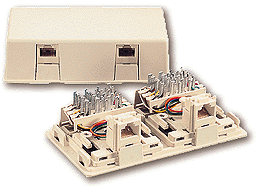
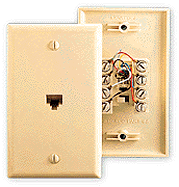
The surface jack, is a cube, roughly 2 inches by two inches by 3/4 of an
inch, and mounts on the surface of the wall. It is usually installed after a wall is
constructed, often with wire stapled to the baseboard. They are available
in a variety of colors, with connections for two, three or four pairs.
 |
 |
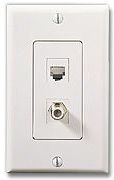
| The flush jack is flat, like an electrical
outlet, and is usually installed in new construction, with wire concealed inside the wall.
Flush jacks are available in a variety of colors, for two, three or four pairs of wire, and in
both standard and "Decora" styles (at right, above). |
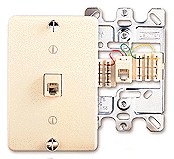 The wall jack, usually mounted
about five feet above the
floor, has two metal mounting studs, to support a wall phone. They are available with
plastic or stainless steel front plates, with two or three pairs of wire. The wall jack, usually mounted
about five feet above the
floor, has two metal mounting studs, to support a wall phone. They are available with
plastic or stainless steel front plates, with two or three pairs of wire.
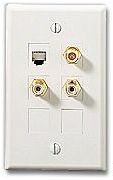
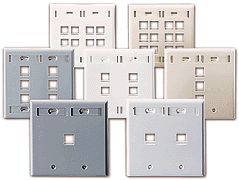
Both surface and flush jacks are available in multi-port
versions, with up to six ports in a single-gang plate or12 ports in double-gang
plate. You can use a mixture of jacks and other connectors, for phone, fax, LAN, modem,
answerer, TV, etc. Multi-port assemblies are available in both standard and Decora styles,
in a variety of colors.
 |
 |
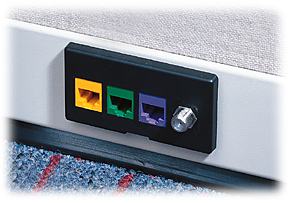
| Special purpose jacks and mounting
plates are available for installation in the floor, outdoors, in modular furniture,
etc. |
|
|