"There
is no communication in the telephone business"
Michael N. Marcus, 1986
"The telephone
business is notorious for using different words to indicate the same thing, and the same
words to indicate different things. The merging of computer and telecom technologies is
making it even worse."
Michael N. Marcus, 1996
 |
In this Website
we generally use key system, rather than PBX terminology.
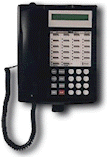
- A key system has multi-line
phones with keys that you press to get dial tone
on a specific line from the phone company's Central Office
(CO). In smaller key systems, incoming calls usually ring at several --
or all -- phones. In bigger key systems, calls usually go to the receptionist
or attendant, who will then tell someone that he or she has a call on a
particular line, often using the intercom to call one phone, or by making
a paging announcement to several people, or throughout a large area.
- With a PBX ("Private
Branch Exchange"), you usually use a single-line phone and have to dial
9 to get dial tone. Incoming calls usually go to a receptionist, attendant or operator,
who transfers the call to the appropriate person.
|
- CO, by the way, is pronounced see-oh.
It's not "company" or "co."
- Also by the way, when you see "no"
on the display on a Panasonic phone, it means "number."
- KTS is the abbreviation for Key
Telephone System, often called just a Key System.
- The heart (or brain) of a KTS is its KSU
(Key Service Unit). Some telecom newbies say Key System Unit.
Computer guys often call it a Central Processing Unit, or CPU.
Old telecom guys call it a switch. Cardiologists call it a heart.
Neurosurgeons call it a brain.
- An individual module inside a KSU used to be
called a KTU (Key Telephone Unit), but this term is
disappearing.
- Our Panasonic phone systems combine features
of key systems and PBXs, and can use both multi-line and single-line phones, so they are
considered hybrid systems.
It's OK to say dial, even if
you make your calls by tapping buttons on a touch-tone pad. Touch-Tone
was originally a trademark of AT&T, but they let the trademark lapse. A maker of
cheapie phones used Touch-Tone as a brand name in the mid-80's, but they seem to have
disappeared. Most phones and phone systems can be switched to produce either touch-tones
or dial pulses (clicks), like old rotary dial phones,
for use with central offices that don't accept touch-tones. The technical term for
touch-tone is DTMF (dual-tone/multi-frequency).
- The actual "dial" on rotary dial
phones is called the finger wheel.
- Rotary has another meaning in the phone business -- the
feature that lets a caller who dials a busy phone number, to automatically connect through
another number. This feature may also called hunting or ISG
(Incoming Service Group) or Call Forward On Busy.
- Phone company features such as Call Forwarding, Conference
Call, Speed-Dial, Call-Waiting, Re-Dial, Call Return and Caller ID, are often called Custom
Calling Services, as distinct from POTS (Plain Old
Telephone Service). POT, on the other hand, is not a plain old telephone.
| # |
Where's your OCTOTHORPE?
"Octothorpe" is one of many names for the # key - usually found below the 9 and
to the right of 0 on a touch-tone phone. It's also called the tick-tack-toe sign,
cross-hash, cross-hatch, enter, hash, number-sign, noughts-and-crosses, octothorp, pound,
pound-sign and probably other things.
The story of the octothorpe and other vital telecom info is available in the archives of
Telecom Digest.*The asterisk under the 7 and
to the left of the 0, is called Star. |
Just as a ship is a big boat, cable
used to mean thick wire. Computer people have affected telephone
vocabulary, and now "cable" seems be be synonymous with "wire," and
might eventually replace it.
- The name of the British long-distance company,
Cable & Wireless, Ltd. comes from the undersea cables that run around
the world, and "wireless," the Brit term for radio. Cable & Wireless
installed the first telegraph cable between the US and Britain.
- Wireless Cable refers to
cable-like TV programming sent over-the-air to an antenna on your roof or in your attic.
- The term wireless is
also used to describe cellular phones and PCS phones and
phone services.
- The term cordless is
usually reserved for wireless home and business phones that are
generally used indoors. Cordless phones actually have more wires than
corded phones.
- Fancy and/or expensive
cordless phones and cordless phone systems are often labeled
"wireless."
- Wire running from the phone company to your
place is called the local loop.
- Loop plant includes the local
loop, plus all the telephone poles and underground conduit and assorted hardware used to
connect them to you.
- Wire running around inside your place is station
wire, or station cabling.
- The common phone wire that
was used for decades, and now considered inadequate, was called D-station wire. It
was also classified as IOW, because it could be used Inside and Outside.
Wire designed for inside use only, is IW. Most of this wire had
four conductors (with green, red, black and yellow insulation), and was also
called quad.
- Some of the oldest wire, with three or four
conductors twisted together, but with no outer jacket, is called
bridle wire.
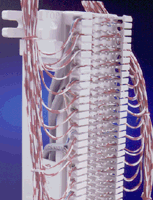 Modern wire without a jacket is
usually cross-connect wire, and is generally used in short lengths to
make connections between two terminal blocks (also called
punch-down blocks). The photo shows single-pair cross-connect
wire that has been punched-down on a common 66M block.
The thicker gray wires visible on the left are station wires, connected to individual
phones. A group of punch-down blocks near the main phone system control unit may be called
a main distributing frame (MDF). A block or blocks
farther away, closer to the phones, is an intermediate distributing frame (IDF). Modern wire without a jacket is
usually cross-connect wire, and is generally used in short lengths to
make connections between two terminal blocks (also called
punch-down blocks). The photo shows single-pair cross-connect
wire that has been punched-down on a common 66M block.
The thicker gray wires visible on the left are station wires, connected to individual
phones. A group of punch-down blocks near the main phone system control unit may be called
a main distributing frame (MDF). A block or blocks
farther away, closer to the phones, is an intermediate distributing frame (IDF).
|
Z |
 Most phone installations now use multi-pair
station wiring inside the walls, usually with four twisted pairs.
The general description is UTP (unshielded twisted pair). It's a good
idea to install more pairs than you think you'll need, for adding more phones and gadgets,
and to compensate for damage by plumbers and mice. Most phone installations now use multi-pair
station wiring inside the walls, usually with four twisted pairs.
The general description is UTP (unshielded twisted pair). It's a good
idea to install more pairs than you think you'll need, for adding more phones and gadgets,
and to compensate for damage by plumbers and mice. |
- Twisted-pair wire varies in the number of
twists per inch. Wire with more twists is better and more expensive. UTP is classified in
various levels or categories.
- Computer networks generally use Cat-5
wire, and phone systems Cat-3 or Cat-5.
- Cat-5 wire is capable of higher data
transmission speeds, and must be installed properly to avoid loss of speed and data glitches.
Special phone jacks and other hardware items are available for use with Cat-5 wire.
- Each phone circuit consists of two wires in a pair.
One wire, with positive electrical polarity, is called the tip
and is traditionally green within a phone jack, the other is negative, called ring,
and is red. The tip and ring terms come from the parts of an
old-fashioned telephone switchboard plug.
- Multi-pair phone wire uses an
industry-standard color code, to distinguish one pair from the others.
Each wire usually has a base color and a contrasting stripe, and the other wire in the
pair is the opposite. The first pair of wires usually has a white wire with blue stripes,
and a blue wire with white stripes. There are codes for 25 different pairs. When cables
have more than 25 pairs, each group of 25 pairs is wrapped with colored nylon thread, in a
binder group.
 |
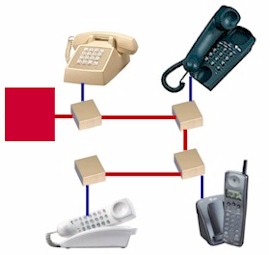 |
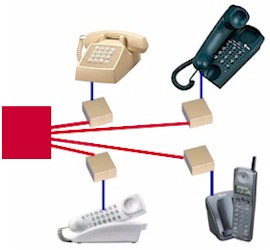
With most phone systems, you need a direct
path from the central control unit to each phone. Phone guys call this home-run
wiring. Computer guys
call it star topography. |
Loop-through is a
less-expensive wiring scheme, often found in homes, where one piece of wire goes from jack
to jack to jack. |
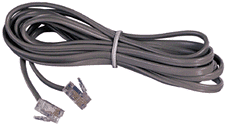 A cord used to mean a short, flexible, and perhaps
temporary piece of wire -- such as the one between the base of a phone and a jack on the
wall. Here, too, computer lingo is taking over. Patch cable is now more
common than patch cord. A cord used to mean a short, flexible, and perhaps
temporary piece of wire -- such as the one between the base of a phone and a jack on the
wall. Here, too, computer lingo is taking over. Patch cable is now more
common than patch cord.
- When a piece of wire is cut to a specific
length and has specific connectors or plugs attached, it is usually called a cord or a
cable, as in extension cord, or modem cable.
- A cord/cable/piece of wire that connects a
phone to a jack is normally called a line cord or sometimes a base
cord or a mounting cord. A standard line cord
is 7' long. Other common lengths are 14' and 25'. You may also find 50'.
- The coiled cord between the base of a phone
and the handset is usually called a handset cord.
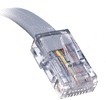 The little plastic tips on the ends of cords and
cables are plugs. Plugs fit into jacks. Despite their
male name, jacks are female. Plugs are male. If you
don't understand this, the next time you're naked, look in the mirror. Modular plugs are
made in three standard sizes. The smallest plug, known as 4-position/4-wire, is used for
handset cords. The middle-size plug is the most common. It has six positions, and either
two, four, or six wires. It is used for most line cords, for connecting phones, modems and
other devices to phone jacks. The largest plug, with eight positions and eight wires, is
usually used for LANs (Local Area Networks) and sometimes for four-line
phones. The little plastic tips on the ends of cords and
cables are plugs. Plugs fit into jacks. Despite their
male name, jacks are female. Plugs are male. If you
don't understand this, the next time you're naked, look in the mirror. Modular plugs are
made in three standard sizes. The smallest plug, known as 4-position/4-wire, is used for
handset cords. The middle-size plug is the most common. It has six positions, and either
two, four, or six wires. It is used for most line cords, for connecting phones, modems and
other devices to phone jacks. The largest plug, with eight positions and eight wires, is
usually used for LANs (Local Area Networks) and sometimes for four-line
phones.
CLICK for a lot more about
wire, jacks & plugs. |
|
- In the computer world, a connector
can be male or female. In the phone world, a connector is female. A CPC adapter has
one (male) plug and two (female) connectors.
- CPE used to mean customer-provided
equipment, or its opposite, company-provided equipment. Now it's
customer premises equipment, like a phone or a modem.
At least one phone company (SNET) says its customer provisioned
equipment.
- People sometimes say they "jack-in"
a phone. That's silly. You plug-in a phone.
- Some people -- even electricians -- call wall
outlets and wall jacks...plugs. That's stupid. Plugs go on
wires, not on walls.
- Even though almost all phone jacks go on the
wall, the term wall jack is reserved for jacks that are designed to
support a wall phone.
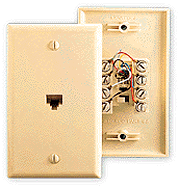
- The mushroom-like pieces on a wall jack that
fit into slots on wall phones are mounting studs.

Other jacks include surface jacks
(like in the picture at left) that stick out from the wall, and flush jacks
that are nearly flat, like an electrical outlet (also called a receptacle).
- Surface jacks are often called baseboard
jacks, but in modern houses, the baseboard is often replaced by a small strip of
molding that is too small to hold a jack, so the jack goes above the baseboard. Surface
jacks are also called biscuit jacks.
- Jacks that connect directly to the phone
company have RJ designations. RJ stands for Registered Jack,
and refers to FCC-established standards. A single-line jack for a wall phone is an RJ-11W.
A two-line jack for a desk phone is an RJ-14C. The RJ designation refers
to the way a particular piece of hardware is connected at a particular time -- it is not a
part number. An RJ-11C, RJ-14C, and RJ-25C can be physically identical,
but differ in the number of phone lines connected to them. Many people call an 8-wire jack
used for a phone or a computer network an RJ-45. That's a mistake,
because an RJ-45 is a jack used to connect a data terminal to a phone line, but since the
same piece of hardware can be used for terminals, networks and phones, any 8-wire jack is
commonly called an RJ-45.
- The W in RJ designations
stands for wall. Nobody seems to know what the C stands
for. There are other suffixes, including X.
- RJ21X is a common phone
company demarcation point (demark) for up to 25 lines.
 |
In this Website, we use the term line
to refer to an individual two-wire circuit (a pair) between your office
or home and the phone company. One pair of wires generally provides service for one phone number. |
- There are ways to get more out of a pair of
wires, and alternatives to wire.
- A SLCC (pronounced slick, and
standing for Subscriber Line Carrier Circuit) is used by phone companies
when they need to provide dialtone where there is insufficient wire running through the
street. It can provide up to 96 derived lines. The smallest unit can
squeeze two calls out of one pair of wires. The line voltage on derived
lines is usually much lower than the 48 volts on normal lines, and may confuse some
multi-line phones. Hold circuits may not work, and in-use lights may be on even when the
phone is hung up.
- A T-1 circuit can provide 24
conversations (or data transmission paths) using two pairs of wire. It is commonly used to
connect several offices of one company, or to allow a business to connect directly to a
long-distance provider, without passing through the local phone company's facilities. Some
phone systems can connect directly to a T-1 line, others use an adapter called a channel
bank.
- Fiber-optic cables use very thin strands of
glass, instead of copper wire, and can carry a huge number of conversations, as well as
data and video.
- Microwave uses extremely high frequency radio
transmission to carry voice, data, and video between dish-shaped antennas, and is used by
phone companies in private networks. The "M" in MCI, stands for
Microwave, which the company used in its early days as an alternative to AT&T long
distance service.
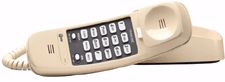 |
In this Website, we use phone
to mean an individual telephone instrument. |
- In PBX lingo, a line is called a trunk
and a phone can be called a line, or an extension. In
both key systems and PBXs, phones are often called stations.
- People who have worked in offices for a long
time often call a phone line a wire, as in "I'm sorry, but Mr.
Witherspoon is on another wire."
- Old phone guys often call phones, sets.
A wall phone is a wall set and a desk phone is a desk
set and a multi-line phone is a key set.
- You may also hear phones referred to by their
traditional model numbers. An old-fashioned rotary-dial desk phone is a 500-set. An
ordinary touch-tone phone is a 2500-set.
- Phone company customers used to be called subscribers,
and telco (telephone company) old-timers often called phones,
subsets.
- Old electromechanical key telephones
sometimes were referred to with generic numbers, such as K-10 for a key
phone with 10 buttons.
- In Bell-Talk, single-line phones were often called
CVs (pronounced "see-vees") and key phones were called KVs
(pronounced "kay-vees'). If they went on the wall, they'd be a CVW
or KVW.
- CVs were sometimes called C-sets.
- These terms were part of the Bell System USOC (UNIVERSAL
SERVICE ORDERING CODE) which consumer and business customers have seldom
encountered since the AT&T breakup in 1983. The code included standardized
abbreviations for a huge number of hardware items, and were listed on installation orders.
The USOC is now used in the wholesale side of the telecom business, where, for example, a
competitive local exchange carrier (CLEC) orders service from a telco for
resale to its customers. (Thanks to Ray Keating for his help on this.)
- An installation order for a key system was called a K-Plan,
and had a chart that showed the functions of each button on each phone.
- K-Plan is different from K-Plant, which was
all the key system equipment and support and distribution facilities owned by a phone
company. K-Plant almost became a "place" in the minds of phone guys, as in
"Joe's in K-Plant."
- Bell's actual hardware items (jacks, adapters, transformers,
etc.) often carried a KS designation.
- KS stood for Kearney System, a parts
numbering scheme developed for a Western Electric factory in Kearney, NJ. Even today, some
common pieces of telecom hardware are marked with KS numbers.
- You might also find pieces of telecom gear with a ComCode,
another Bell/Western Electric part number scheme. One 50-cent part can have a dozen
different identifiers.
- Phones are often refurbished after being
removed from service, so they will look and work like new for other customers. In the old
Bell system, refurbished phones and gadgets were known as C-Stock.
- ATT (later Lucent, and now Avaya) sometimes likes to call its
phones voice terminals. I think that's silly and pompous and confusing.
- Some people call phones handsets,
which is not very pompous, but is even more confusing.
-
 The handset is the part of the phone that
goes in your hand, and includes the parts you listen to and talk into. The handset is the part of the phone that
goes in your hand, and includes the parts you listen to and talk into.
-
 If those parts were attached to something that
attached to your head or your ear instead of being held in your hand, it would be called a headset,
instead of a handset. If those parts were attached to something that
attached to your head or your ear instead of being held in your hand, it would be called a headset,
instead of a handset.
- The important components inside a headset or
handset are the transmitter and the receiver. What some
people call receivers, are really handsets.
- Some people even call their entire phone a
receiver. Yuck.
 When you hang-up briefly to get dialtone for a new call,
or to activate call-waiting or another feature, you flash the
hookswitch. When you hang-up briefly to get dialtone for a new call,
or to activate call-waiting or another feature, you flash the
hookswitch.
- "Flash" refers to a light on an
old-fashioned switchboard that would let the operator know that you need help. The
"hookswitch" refers to the actual on-off switch inside the phone that would be
activated by hanging up or picking up the handset.
- When you pick up the handset, you go off-hook.
- When you hang up, you go on-hook.
- "Hanging up" refers to the actual switchhook
on old phones, where you would hang the receiver.
- A lot of our current telecom vocabulary is
based on the parts of ancient phones, like the candlestick above.
- Some phones have buttons labeled flash
and some fax machines have hook buttons.
The switchhook's connected to the
hookswitch...and the headbone's connected to the neckbone, and that's alright with me.
Michael N. Marcus |