|
AbleComm: Panasonic Phone Systems & Phones. Phone System Evolution © 1997- 2004 AbleComm, Inc. All Rights Reserved. history.htm 10/16/04 Email Newsletter AbleComm.com Home AbleComm.info Home Call toll-free, 1 888 ABLE 999 ORDER ONLINE |
|
|
AbleComm: Panasonic Phone Systems & Phones. Phone System Evolution © 1997- 2004 AbleComm, Inc. All Rights Reserved. history.htm 10/16/04 Email Newsletter AbleComm.com Home AbleComm.info Home Call toll-free, 1 888 ABLE 999 ORDER ONLINE |
|
|
||||||||||
 To select a specific line, boss
or secretary could press a button. Perhaps
because the button opened and closed a circuit, it was called a "key." Or maybe it was called a key because
pressing it reminded someone of pressing a piano key or a telegraph key. At any rate, multi-line phones
became known as "key phones," and the relays and wires and other stuff they got
connected to was called a "key telephone system,"
or "KTS" in Bell System lingo. To select a specific line, boss
or secretary could press a button. Perhaps
because the button opened and closed a circuit, it was called a "key." Or maybe it was called a key because
pressing it reminded someone of pressing a piano key or a telegraph key. At any rate, multi-line phones
became known as "key phones," and the relays and wires and other stuff they got
connected to was called a "key telephone system,"
or "KTS" in Bell System lingo. |
||||||||||
|
But despite many companies offering a huge variety of systems and accessories, these "electromechanical" key systems had one thing in common: a lot of wires. |
||||||||||
|
||||||||||
|
||||||||||
|
||||||||||
|
These fancier features could be handled by plain-Jane phones working on just one pair of wires, but the system still needed Jane or Betty or Ernestine to sit at a console and direct incoming calls to the right people. And you'd better make sure that someone else could cover for her at lunch time and sick time and vacation time. On the other hand, companies using key systems did not need dedicated ladies to answer the phone. Tom, Dick and Harry could answer any line on their multi-button phones, and then put the call on hold and yell "It's for you." The world was heading for a collision. Convenient key phones saved money by eliminating the expensive switchboard operator, but the heavy cables were expensive to install, modify, and repair. |
||||||||||
|
This made life much easier for installers, which meant that installations could be cheaper and more reliable for the phone system's owner. Simultaneous advances in microcircuitry allowed formerly-expensive add-ons, like speakerphones and SMDR ("Station Message Detail Recording"), to be included for just a few extra bucks. |
||||||||||
|
||||||||||
|
The central control box that provides brain power for a key system has shrunken from the size of a file cabinet to a medicine cabinet (or even smaller), and is cooler, quieter, and has very few moving parts to wear out. Adding additional lines, phones and features usually requires just plugging in a circuit pack, instead of connecting dozens and dozens of accursed wires. Electronic phone systems could be wonderful, but many early models stunk. Some products were put on the market before they had been fully developed, others had strange responses to particular kinds of wire or environmental factors, and some were simply over-priced or under-built. But by the early 1980s, there were plenty of superb electronic systems around. Some, such as those sold by TIE and Asuzi were also particularly good values, and they eventually won over the hearts and minds of even the most retrograde cynics. Very few companies sell or use electromechanical phone systems now, but they are still found in government offices and on David Letterman's desk. |
||||||||||
|
"Digital" means more than having a display panel that shows the time and the number dialed. "Digital" has been the major buzzword in the electronics industry for over a decade, but few people outside the business understand the technology or its benefits. Complex numerical data, printed and spoken words, even music and moving color pictures, can be represented by a series of ones and zeroes, and then be stored, manipulated, transmitted, received and perfectly reproduced. This technology is responsible for a wide range of new and improved products and services, such as noise-free music on compact discs, super-sharp direct-from-satellite television, complex video games, movie morphing and other special effects, your PC, quiet car phones, faster faxing and voice mail. In office phone systems, digital technology has led to the development of multi-line, multi-feature phones that use just two wires (one "pair"), instead of the four or more wires that used to be needed. Traditional electronic phone systems used one pair for voice plus one for data (such as instructions for connecting lines and turning on lights), and maybe a third pair for off-hook call announcing. Digital phones convert voice into data, so it can flow through the same wires as other information and instructions. Digital phone systems generally have more features than analog systems. For most people, digital vs. analog simply should not matter. It's a distinction without a difference. In a business or home phone system, one technology does not sound better or provide more reliable telecommunications than the other. Digital phone systems have some analog components. Analog phone systems have lots of digital circuitry. AbleComm is going to gradually stop describing phone systems as analog or digital, and we recommend that you make your decision based on features, esthetics and price, not buzzwords or snobbery. |
||||||||||
|
||||||||||
|
If a person or department isn't very important, you plug in a $25 phone, and it works PBX-style, by dialing nine for outside dial tone. If the person or department gets more important, the inexpensive phone can easily be replaced with a fancier model, that works key-system-style, with lights and buttons and a speaker and maybe an alphanumeric display. |
||||||||||
| What's ahead? | ||||||||||
|
|
 |
|
| Call us toll-free, 1 888 ABLE 999 | |
002
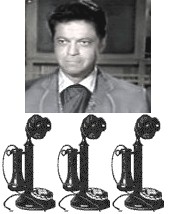 In the early 20th
century, every textile tycoon and railroad baron had a
collection of tall black phones on top of his desk. When a phone rang, his
frazzled secretary scrambled to pick the right one; and while wheeling
and dealing with one guy, and a call came in from another, Mr. Big stuck the first phone
in a drawer to keep his secrets from being overheard. This was not very efficient.
In the early 20th
century, every textile tycoon and railroad baron had a
collection of tall black phones on top of his desk. When a phone rang, his
frazzled secretary scrambled to pick the right one; and while wheeling
and dealing with one guy, and a call came in from another, Mr. Big stuck the first phone
in a drawer to keep his secrets from being overheard. This was not very efficient.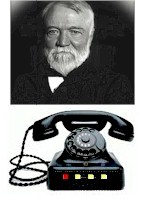 In the middle of the
roaring twenties, some Bell System bright guy had a better idea. Instead of having
a bunch of phones on one desk, he put a bunch of lines on one phone, freeing vast
acres of desktop real estate and making life simpler for the Vanderbilts, Carnegies and
Wannabees.
In the middle of the
roaring twenties, some Bell System bright guy had a better idea. Instead of having
a bunch of phones on one desk, he put a bunch of lines on one phone, freeing vast
acres of desktop real estate and making life simpler for the Vanderbilts, Carnegies and
Wannabees. 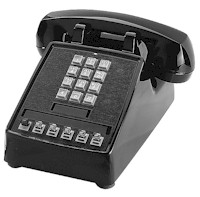 Over the next 50 years, key systems got more complex and more
convenient, with features like hold buttons, lights, intercoms, paging, speakerphones,
privacy, music-on-hold, long-distance restriction, timers and memory dialing, from
AT&T and a growing number of worldwide competitors.
Over the next 50 years, key systems got more complex and more
convenient, with features like hold buttons, lights, intercoms, paging, speakerphones,
privacy, music-on-hold, long-distance restriction, timers and memory dialing, from
AT&T and a growing number of worldwide competitors. 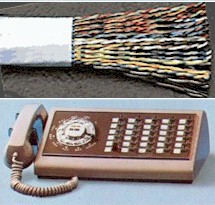 There was a separate two-wire electrical circuit for each phone
line, going from a central control box to each phone where that line was available. Most
phones also had an additional pair of wires for the light that indicated the status of a
line, and another pair for "A-lead control"
which operated the light and the hold circuit. With six wires per line, a mid-fifties
"Call Director"
(above) with lots of lines
could require 150 wires, in a clumsy cable as thick as a garden hose.
There was a separate two-wire electrical circuit for each phone
line, going from a central control box to each phone where that line was available. Most
phones also had an additional pair of wires for the light that indicated the status of a
line, and another pair for "A-lead control"
which operated the light and the hold circuit. With six wires per line, a mid-fifties
"Call Director"
(above) with lots of lines
could require 150 wires, in a clumsy cable as thick as a garden hose.
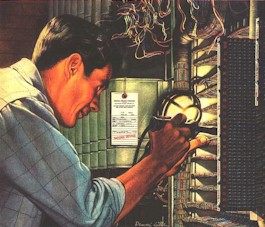 That cable was not pretty to look at, and was no picnic to install.
Technicians cursed each wire, and the chances of putting a wire in the wrong place
increased with the complexity of an installation. If a line or a light stopped working,
finding the broken wire in a dark and crowded cable closet could be an all-day affair, and the more
wires in the closet, the more likely that some of them would get broken, and stay broken.
That cable was not pretty to look at, and was no picnic to install.
Technicians cursed each wire, and the chances of putting a wire in the wrong place
increased with the complexity of an installation. If a line or a light stopped working,
finding the broken wire in a dark and crowded cable closet could be an all-day affair, and the more
wires in the closet, the more likely that some of them would get broken, and stay broken.
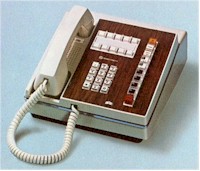
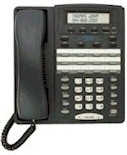

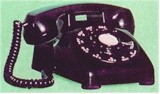 Meanwhile, there were businesses that had lots of phone lines, but just one
simple pair of wires going to just one simple phone on each desk. They were connected to a
PBX system ("Private Branch
Exchange") which was a smaller version of the phone company's Central Office
exchange.
Meanwhile, there were businesses that had lots of phone lines, but just one
simple pair of wires going to just one simple phone on each desk. They were connected to a
PBX system ("Private Branch
Exchange") which was a smaller version of the phone company's Central Office
exchange.
 The PABX (with the
"A" standing for "automatic") still needed an operator or receptionist
to direct incoming calls to the right people, but you could get a dial tone to make a call
by simply dialing "nine" instead of begging Betty to plug you in; and by dialing
other digits, you could call other people within the business. Fancier PABXs allowed users
to put calls on hold, transfer calls to other departments, set up multi-person conference
calls, dial numbers from memory, choose specific lines for specific calls, and create
automated records of calling costs.
The PABX (with the
"A" standing for "automatic") still needed an operator or receptionist
to direct incoming calls to the right people, but you could get a dial tone to make a call
by simply dialing "nine" instead of begging Betty to plug you in; and by dialing
other digits, you could call other people within the business. Fancier PABXs allowed users
to put calls on hold, transfer calls to other departments, set up multi-person conference
calls, dial numbers from memory, choose specific lines for specific calls, and create
automated records of calling costs. 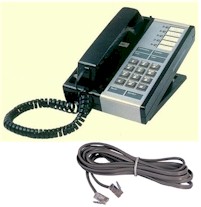 Instead of a collision, there was a solution. A technical solution.
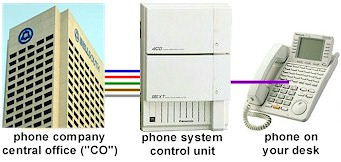
In the late 1970's, a number of innovative companies developed electronic
key systems, that used inexpensive and easy-to-install "skinny
wire" with just four-to-eight copper strands instead of dozens or hundreds.
Instead of a collision, there was a solution. A technical solution.
In the late 1970's, a number of innovative companies developed electronic
key systems, that used inexpensive and easy-to-install "skinny
wire" with just four-to-eight copper strands instead of dozens or hundreds. 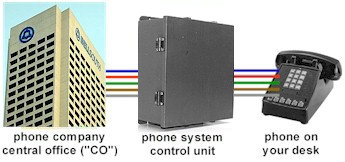
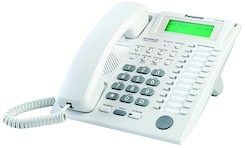 In place of incandescent bulbs that start burning out the first time
they light up, modern phones use Liquid Crystal Displays ("LCDs") and Light-Emitting Diodes ("LEDs") that use less power than bulbs, and should
still be shining brightly when the Klingons make peace with the United Federation of
Planets.
In place of incandescent bulbs that start burning out the first time
they light up, modern phones use Liquid Crystal Displays ("LCDs") and Light-Emitting Diodes ("LEDs") that use less power than bulbs, and should
still be shining brightly when the Klingons make peace with the United Federation of
Planets. 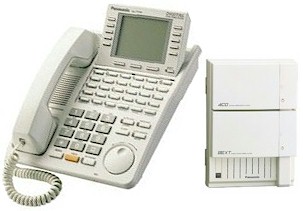 The excitement today, is in phone systems that are not just
electronic, but digital.
The excitement today, is in phone systems that are not just
electronic, but digital. 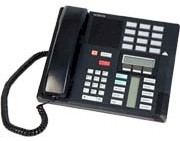 Most phone
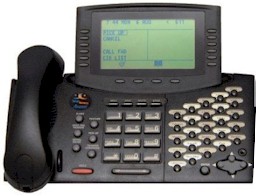
manufacturers have digital products today. Some, such as ATT's Merlin II and Panasonic's
KX-TD1232 evolved from earlier analog systems. Nortel Networks' popular Meridian Norstar
(above) was a completely new design.
Most phone
manufacturers have digital products today. Some, such as ATT's Merlin II and Panasonic's
KX-TD1232 evolved from earlier analog systems. Nortel Networks' popular Meridian Norstar
(above) was a completely new design.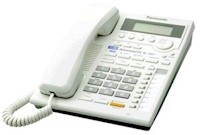 Analog system development has not stood still, however. One recent
trend is a growing number of feature-rich "KSU-less" systems, that provide
super-simple installation by eliminating the central control unit. Phone
above is the Panasonic KX-T3282, with two lines and intercom.
Analog system development has not stood still, however. One recent
trend is a growing number of feature-rich "KSU-less" systems, that provide
super-simple installation by eliminating the central control unit. Phone
above is the Panasonic KX-T3282, with two lines and intercom.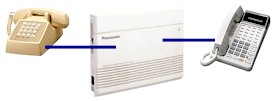 There is also a growing popularity in "hybrid"
phone systems, that combine features of both key systems and PBX systems, and can work
with both multi-line phones and single-line phones.
There is also a growing popularity in "hybrid"
phone systems, that combine features of both key systems and PBX systems, and can work
with both multi-line phones and single-line phones. 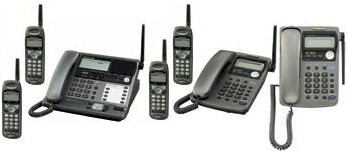 Look for more interaction between phones and computers, and more phone systems that don't need wires.