Answers to Frequently-Asked
Questions
FAQ #62:
What's a KSU and do I need one?
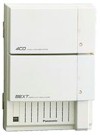 A multi-line telephone system usually includes
phones, wire, jacks and other hardware, and a central control unit, which is a specialized
computer often called a "KSU" (Key Service Unit). A KSU
is usually about the size of a medicine cabinet, and mounts on a wall, and needs a nearby
electrical outlet. We offer a variety of digital and analog control units, with different
capacities, features and prices. A multi-line telephone system usually includes
phones, wire, jacks and other hardware, and a central control unit, which is a specialized
computer often called a "KSU" (Key Service Unit). A KSU
is usually about the size of a medicine cabinet, and mounts on a wall, and needs a nearby
electrical outlet. We offer a variety of digital and analog control units, with different
capacities, features and prices.
The control unit distributes power to the phones,
sends dial tone to them from the phone company's incoming lines, makes the phones ring,
generates touch-tones, connects phones together for intercom and paging, provides
connections for accessories such as music-on-hold and door intercoms, and contains
circuitry for basic phone functions, plus memory for functions and features.
Phone systems using KSUs generally require "home-run"
wiring, with a direct path from the KSU to each phone jack. There is a simpler kind of
wiring often found in homes, called "loop-through" or "daisy chain"
wiring where the circuit starts at the source of dial tone, and then goes to the first
jack, and then the next and the next.
|
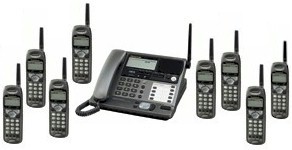
A growing number of
KSU-less phone systems use "cordless" handsets. The
handsets are not completely cordless: they need a power cord for
their chargers, but no phone cord, so they can go almost anywhere.
The Panasonic KX-TG2000 and 4000 can have up to eight cordless
2-line or 4-line phones, with individual voicemail boxes. CLICK |
Home-run wiring is the first choice for new construction, because it
allows you much more freedom in your choice of phone equipment, and it makes it easy to
isolate and repair damaged wire. However, if you want to use loop-through wiring that is
already in your walls, you can choose a "KSU-less" system, that
provides many of the features of traditional KSU-based systems.
AbleComm's new phone-system.com
Website specializes in KSU-less systems.
Most KSU-less phones have one or two cords that plug
into standard phone jacks. You'll find an additional cord that has to be plugged into an electrical outlet.
This can be inconvenient or unsightly in some locations, particularly for wall-mounted
phones.
Living with extra cords is the price you'll pay to avoid the KSU and
costly/complicated installation. But if one phone fails, you unplug it, and the others
keep going. If there was a malfunction in a KSU, all your phones might act funny or stop
working. |
 Home
Email Catalog
Main Page Online
Ordering
Home
Email Catalog
Main Page Online
Ordering
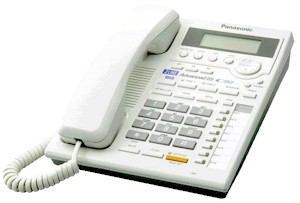 Panasonic's
KSU-less
Panasonic's
KSU-less