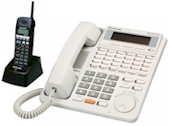
The first Panasonic Digital Super Hybrid phone system control units
were introduced in 1993. The first revision
("dash one") came out in 1996. Since then, we've
progressed through "dash two" and "dash three",
and now Panasonic is making "dash four" versions of the
D816 and D1232 units.
(The latest version of the KX-TD308 is dash
three. The latest version of the KX-TA624 is dash three.)
The dash refers to the way model
numbers are printed, such as "KX-TD816-4." The actual
products are usually identified with a number in a circle on the
bottom of the unit, either on the serial number plate, or on a
separate sticker attached nearby.
Here's what's new:
- KX-TD187 T1
Circuit module (for KX-TD1232-4 only). Allows
connection of a 1232 system to a digital T1 trunk, providing up
to 24 voice channels. It can support any of these line types:
loop start, ground start, TIE, 2-Way DID, OPX. In twin cabinet
systems it must be installed in the master. When a 187 is
installed, you can't have a TD180, TD185, TD284, TD382, TD384 or
TD386 module in either cabinet. The eight original CO line
circuits in the slave cabinet can not be used. The eight CO
circuits in the master, when used with the T1 module, can
provide 32 CO lines, as compared to a maximum of 24 lines in a
twin system without T1. The TD187 must be connected to the phone
company circuits with a Channel Service Unit ("CSU"), purchased
separately. AbleComm price for the KX-TD187 is $1362, with FREE
"ground" shipping in the US. The CSU costs $496, also
with free shipping.
- KX-TD198 Remote
Access module (for KX-TD816-4). Provides remote
programming and diagnostics. It mounts on the front of the
cabinet, and can be sandwiched between the cabinet and a circuit
mule (KX-TD170, 171, 180 or 185). AbleComm price for the
KX-TD198 is $338, with FREE "ground" shipping in the
US.
- TAPI 2.1
Compliance. The new 816 and 1232 conform to
Microsoft's "TAPI 2.1" standard for Computer Telephone
Integration. Previous generations used the "TSAPI"
standard from ATT and Novell.
- Lunch/Break
Mode. Previous generations of these systems
provided ringing patterns and other features based on night or
day. The dash-fours have a third type of setting for lunchtime
or other breaks from the normal schedule, and can be activated
either manually of automatically. More about this later.
- Multiple Message Waiting
Lamps. IMPORTANT
STUFF. You
can now have more than one message waiting light/button on a
single proprietary phone, and several phones can have
light/buttons for the same mail box. Additionally, phantom
extensions can have message waiting light/buttons. A maximum of
128 light/buttons can be set up in a system.
- Voice Mail Port Name
Display. Your
phones can display a name with up to ten characters to let you
know which port a call is coming from. This could be useful if
you have different ports for business and personal use, or for
multiple businesses sharing a system.
- Selectable Flashing or
Steady FWD/DND light. Lots
of people HATE the flashing FWD/DND button on their phone, and
shut it off and lose system functions. With the dash four
revision, you can select steady or flashing for DND and for FWD.
I'd like to have a flashing message-waiting light -- the steady
light is too easy to ignore.
- All phones in a group
can leave it. It's
now possible for all phones in a hunting group, UCD group, ring
group or phantom extension group to log out of the group.
- Restricted flexible
button programming. You
can now stop people from changing the functions of their
flexible buttons, by Class of Service.
- Call Forwarding setup
with software. Call
Forwarding can now be set using PC software, instead of having
to program at each individual phone.
- Variable Forward/No
Answer time. Each
phone can now be set to have its own time to forward un-answered
calls, with one to 12 rings before forwarding.
- Beep On Hold.
Previously, callers who were put on hold would hear either
silence, or music or messages fed into the system. Now you can
have a periodic beep. It's boring, but reassuring. What we
really need are multiple inputs that can be assigned to
different lines.
- TVS50 LCS Display
change. The dash
fours will display Caller ID info for Live Call Screening in
hands-free mode and private mode, with the KX-TVS50 voice
processing system.
NOTE: A dash four can be
used only with another dash four in a twin-cabinet
("tandem") system. A dash two or dash three can be
upgraded to dash four with a chipset change.
 |
The dash fours are supplied with a hernia-inducing stack of
books weighing over 6 pounds -- more than the weight of a
KX-TD308.
Here's what you get:
- A 367-page "programming guide" - like part of
the previous installation manuals.
- A 289-page "features guide," similar to the
user manuals supplied with the the previous systems.
- A 27-page "installation manual addendum,"
covering features introduced in the dash three systems. It
appears that the same material is in the "programming
guide," so this book is probably superfluous,
redundant, repetitive and unnecessary.
- A 400-and-something-page "user manual," which
seems to be the same one supplied with the dash threes,
and does not include dash four features. So...it's likely
inadequate as well as superfluous, redundant, repetitive
and unnecessary.
- A 155-page "installation manual," which may be
eliminated after the first few months of
production.
|
PRICES
for the dash fours are the same as the dash three systems.
Call 1 888 ABLE 999
or
ORDER ONLINE
.
|
 Home Email Catalog
Main Page
Online Ordering
Home Email Catalog
Main Page
Online Ordering