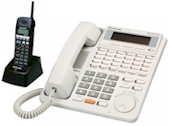
The first Panasonic Digital Super Hybrid phone system control units
were introduced in 1993. The first revision
("dash one") came out in 1996. Since then, we've
progressed through "dash two" and "dash three"
and "dash four";
and now Panasonic is making "dash five" versions of the
D816 and D1232 units.
(The latest version of the KX-TD308 is dash
three. The latest version of the KX-TA624 is dash four.)
The dash refers to the way model
numbers are printed, such as "KX-TD816-5." The actual
products are usually identified with a number in a circle on the
bottom of the unit, either on the serial number plate, or on a
separate sticker attached nearby.
Here's what's new:
- Like the analog 624 and 1232, the new
digital 816 and 1232 can handle up to FOUR door intercom speakers,
when used with the new KX-TD161 door intercom module.
You can select from eight different ringing sounds for each door.
- The KX-TD1232-5 has an
automatic recovery
feature for twin-cabinet systems.
- Remote
Call Forwarding Set allows users who are out of the
office or away from their desk to remotely forward their calls to
another extension or outside telephone. The system can be set to
Forward All Calls, Forward Busy Calls, Forward No Answer Calls,
Forward Busy or No Answer Calls, Forward to a CO or Cancel Call
Forward.
- When digitally integrated with a
Panasonic voice processing system, such as the new KX-TVS110,
the clocks in each system will be
automatically synchronized with each other, so the
voice processor clock will be changed automatically any time the
phone system clock is changed.
- Caller ID
announcement with voicemail messages from Panasonic
voice processors.
NOTE: A
dash five can be used only with another dash five in a twin-cabinet
("tandem") system.
A dash four made in
December 2000 or later can be upgraded to dash five with a chipset change.
PRICES
for the dash fives are the same as the dash four systems.
Call 1 888 ABLE 999
or
ORDER ONLINE
.
|
 Home Email Catalog
Main Page
Online Ordering
Home Email Catalog
Main Page
Online Ordering