|
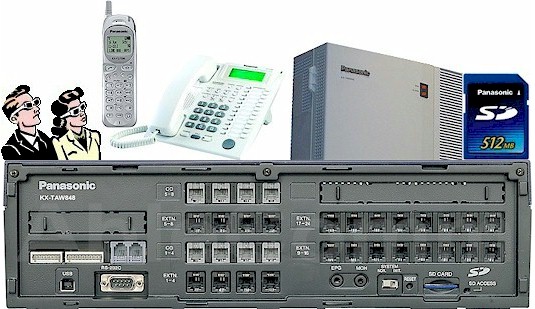
Panasonic KX-TAW848: a
nearly perfect home phone system.
by Michael N. Marcus
Although most of its engineering and marketing efforts have been aimed at
businesses, Panasonic has dominated the residential phone system market for
about 20 years. Lately, Panasonic and other phone system makers have had to
compete with cordless phones and cellphones, which offered portability,
small size and features that traditional wired systems didn’t provide.
The
new Panasonic KX-TAW848 “Advanced Hybrid & Wireless telephone system” is an
extremely well-thought-out response to the new competition, and the needs of
upscale homes and small businesses.
The
KX-TAW848 is a perfect upgrade for anyone who already has a Panasonic phone
system -- even a 15-year-old KX-T616; or for someone who is starting from
scratch. It provides important and innovative features that were either
unavailable or extremely expensive just a few months ago.
Like
previous Panasonic KX-T and KX-TD series phone systems, the KX-TAW848 lets
you connect multi-line proprietary wired “system” phones, as well as
single-line phones and devices such as fax machines, modems, answerers and
TiVo boxes -- with no big-buck adapters or tedious programming.
 But
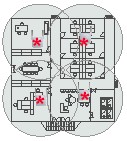
the major new feature in the 848 is its innovative wide-coverage
Multi-Cell
wireless operation that allows you to
wander through a large home or yard, as your call is “handed off” from one
cell station to another, without interrupting your call. But
the major new feature in the 848 is its innovative wide-coverage
Multi-Cell
wireless operation that allows you to
wander through a large home or yard, as your call is “handed off” from one
cell station to another, without interrupting your call.
 This
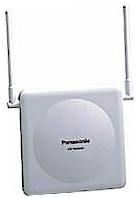
is accomplished by installing multiple cell stations (transceivers) in your
home, and connecting them to the KX-TAW848 control unit. You only need one
pair of wires connected to each cell station, and no power connection. Each
cell station can be up to 1640 feet away from the KX-TAW848 control unit,
and uses “home-run” wiring – you can’t chain several together on one pair of
wires. The cell stations are not weatherproof, but you could install them
outdoors in a suitable housing made of fiberglass or plastic. This
is accomplished by installing multiple cell stations (transceivers) in your
home, and connecting them to the KX-TAW848 control unit. You only need one
pair of wires connected to each cell station, and no power connection. Each
cell station can be up to 1640 feet away from the KX-TAW848 control unit,
and uses “home-run” wiring – you can’t chain several together on one pair of
wires. The cell stations are not weatherproof, but you could install them
outdoors in a suitable housing made of fiberglass or plastic.
Range
from cell station to wireless phone varies with the environment, but is fine
for a big home and a big yard. You should be able to go the length of
several football fields, and up or down three floors, with excellent voice
quality.
One
cell station can support two calls simultaneously. You can connect up to
four cell stations to a system, and up to 28 wireless phones can be
registered with the system (but only eight can be in use at one
time).
Figuring out the maximum capacity of this system can be confusing, and even
its 848 model number is a misnomer. “KX-TAW851” would be a more accurate
label, because the system could be set up for 51 phones (23 wired and 28
wireless); but few people would use that configuration. A maximum of 25
phones can be in use at one time, or 24 if you have a voicemail system
connected.
Intercom traffic is “non-blocking.” You can have as many intercom
conversations going on, as you have active pairs of phones.
 |
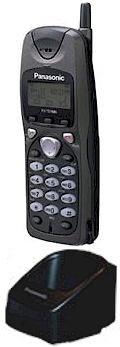 |
The KX-TAW848 works
with two new 2.4GHz digital wireless phones: KX-TD7680 and 7690.
Both have speakerphones and hands-free intercom, but can't receive
voice paging announcements.
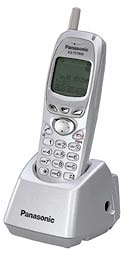
The premium
“executive” model KX-TD7690 is silver, sleek, extremely lightweight,
and looks like a cellphone. It can easily fit into a shirt pocket.
It has a 5-line backlit LCD screen, a navigation key for line
selection and feature access, and is equipped with a convenient
2.5mm headset jack. It has a long-life lithium ion battery pack, and
can be used with an optional belt holster.
The lower-cost
standard wireless handset, the KX-TD7680, is slightly larger (more
like a “pocketable” home cordless phone) and it has a 3-line backlit
LCD display, navigation key, line selection and feature keys and a
2.5mm headset jack. It uses a NiMH battery pack, and comes with a
belt clip.
|
Panasonic has offered
hands-free speakerphone operation in consumer cordlesses before, but this is
the first time the feature has been available in “system phones.” Voice
quality is quite good, and volume is adequate for table-top use. You can
also hold the phone in front of you and talk Nextel-style, but you won’t
have to push to talk.
Wireless phones can be
registered on more than one KX-TAW848 system, so you can take your handset
from your home and use it on your office system, or vice-versa. Most people
will probably also want some wired phones around the house, where you need
more buttons, bigger buttons, bigger displays, louder speakerphones, less
expensive phones, and paging announcements.
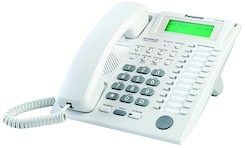 The
KX-TAW848 is designed for installation with Panasonic’s current line of
KX-T7700 series wired telephones as well as older models like the KX-T7000
and KX-T7300 series telephones. KX-T7700 series phones are available in a
beautiful charcoal color, and an off-white that’s fine for kitchens, baths
and bedrooms, or next to an off-white PC. The
KX-TAW848 is designed for installation with Panasonic’s current line of
KX-T7700 series wired telephones as well as older models like the KX-T7000
and KX-T7300 series telephones. KX-T7700 series phones are available in a
beautiful charcoal color, and an off-white that’s fine for kitchens, baths
and bedrooms, or next to an off-white PC.
There
are four models to choose from, with different features and prices. All
models have 2.5mm headset jacks and 24 programmable buttons – 12 with
multi-color LEDs. The top model is the KX-T7735. Its display can show three
lines of text, making it the best choice if you have Caller ID, because it
can display a caller’s name and phone number at the same time. For business
use or a really large house, you can install a “DSS/BLF” panel that shows the status of all the phones in the
system, and allows quick intercom calls and transfers.
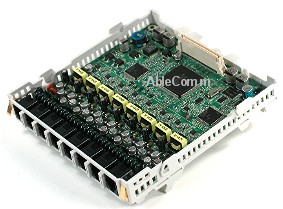
The
KX-TAW848 has a simple-to-install modular design allowing you to tailor your
system to your specific needs. It is initially configured with hardware to
support four outside lines and four phones. By adding expansion cards, it
can grow up to its maximum capacity of eight lines and 51 telephones.
Other
circuit cards provide optional features, including:
●
Caller ID with Call
Waiting: This feature lets you see the caller’s name and phone number on the
display of a system phone, so you can decide to either answer the call or
let it get dumped into voicemail (if you have voicemail). Each phone has an
incoming log that automatically stores information on up to 30 calls. Even
if a second call comes in while a line is in use, the second caller’s name
and number will be shown on the phone’s display. A separate optional circuit
card can provide Caller ID on up to eight single-line phones, display boxes
and PCs. This is a feature that Panasonic customers have wanted for a long
time.
●
Direct Inward System Access (DISA)/Fax Detection: This allows people to call
into the system to use various features such as automated attendant, that
can direct outside calls to specific phones (generally not useful in a home,
where people move around from room to room). This circuit module can also
detect an incoming fax tone and automatically transfer the fax call to your
fax machine or PC. This feature requires that calls be answered by the auto
attendant instead of ringing your phones. This is OK for an office, but
generally not a good idea in a home. If you want a line to be shared by a
fax and human beings, a separate automatic fax/voice switch connected ahead
of the phone system is probably a better choice.
●
Door intercom and door
opener: For convenience and safety, the KX-TAW848 works with up to four door
intercom speakers and four electrical contact closures. If a visitor presses
the button on a speaker at one of your doors or at the driveway gate, there
will be a distinctive ring on your phones, and the phone displays will show
where the visitor is. Someone inside the house can then speak to the visitor
from any phone, and even let him or her in, by dialing a code if the system
is connected to an electric door strike or gate opener. If you’re creative,
you can use the contact closures for other remote control functions, such as
turning on whole-house music, or outdoor lighting.
● 8-Channel
echo canceller card: This optional circuit module improves the voice quality
of multi-person conference calls. The system can support up
to 10 3-person conference calls, or three 8-person conference calls.
Previous Panasonic phone systems were limited to 3-person conferencing.
The
KX-TAW848 has “digital integration” for use with Panasonic’s KX-TVS series
Voice Processing Systems. Digital integration speeds up installation and
call handling, and enables advanced features. It also allows one jack in the
phone system to operate two ports in a voice processor, so your system can
accommodate more phones or a bigger voice processor. Panasonic voice
processors provide a wide range of features including voicemail, automated
attendant, live call screening, conversation recording, Caller ID call
handling, remote notification, interview service and message forwarding.
This
is the first Panasonic system with PC software provided for the end-user,
not just the dealer. The Windows-based program has a pompous name
(“maintenance console”) but it’s well designed and easy to use. You can
program your system from a PC with either a DB9 serial connector or a USB
port, or remotely by modem (with an optional card in the system).
The
KX-TAW848 system uses a Secure Digital (SD) card to store its operating
system, and also to store the back-up of data programmed into your system.
Installation is simple, even for the do-it-yourselfer, because all
connections use ordinary modular jacks. There is no need for special tools
or training, and you get a full set of paper manuals.
The
new system is virtually “plug and play.” When you install optional circuit
boards and go through a simple initializing procedure, the 848 recognizes
the new additions and makes new features and increased capacity accessible
through the software. Unlike the KX-TD systems, there is no need to tell the
system what kind of expansion modules you’ve installed in which locations.
If you
already have a Panasonic phone system, it’s very easy to upgrade to the
multi-cell wireless features and larger size of a KX-TAW848. Just unplug the
cords from your old system, take the old box off the wall, put the 848 on
the wall, and plug the cords back in. You can reuse your old telephones and
cabling, saving a lot of time and money. (You can’t use KX-T7200 or KX-T7400
series phones.)
The
cabinet is lightweight and compact (about 10-3/4"W x 14-3/4"H x 4-1/2"D).
You can mount it on a wall, put it on a shelf, or install it in a standard
19” rack and use it with a patch panel and other rack-mount accessories.
The
KX-TAW848 does so much, and does so much so well, it’s hard to criticize. I
can only think of two things to nitpick about: the manual pages are half the
size used in other Panasonic systems, with itty-bitty teeny-weeny type; and
you can’t make paging announcements through the speakers in the wireless
phones. If a perfect phone system rates 100 points, this one gets 98 – and
that’s certainly good enough for most people.
Michael N. Marcus is president of
AbleComm, Inc. (“the telecom department store”), and a writer who
specializes in telecommunications and consumer electronics. He has been the
audio/video editor or Rolling Stone magazine, a columnist and equipment
reviewer for Teleconnect magazine, the phone system guru on CompuServe, and
has written about electronic products for scores of other publications
ranging from Esquire to Country Music. |